Cryptocurrency markets have a reputation for their wild price swings, one day Bitcoin’s soaring, the next it’s plummeting. For many investors, this volatility makes deciding when to buy feel like a gamble. Should they wait for a dip? Jump in now before prices rise? The uncertainty can be paralysing, and mistimed lump-sum investments have burned more than a few hopeful crypto enthusiasts.
Enter dollar-cost averaging, or DCA, a strategy that takes the guesswork out of timing the market. Rather than investing a large sum all at once, DCA involves putting a fixed amount into cryptocurrencies at regular intervals, whether prices are up, down, or sideways. This disciplined approach has become increasingly popular among crypto investors who want to build their portfolios steadily without succumbing to emotional decision-making or the stress of trying to predict market movements. In this guide, we’ll explore what makes DCA effective for crypto investing and how anyone can carry out it the smart way.
Key Takeaways
- Dollar-cost averaging into crypto involves investing a fixed amount at regular intervals, reducing the risk of mistimed lump-sum purchases during volatile market conditions.
- DCA strategically distributes risk by accumulating more cryptocurrency when prices are lower and less when they’re higher, optimising your long-term position.
- Automating your DCA strategy removes emotional decision-making, helping investors avoid panic selling during crashes and FOMO buying during rallies.
- Focus on established cryptocurrencies like Bitcoin and Ethereum for lower-risk DCA, whilst allowing a smaller allocation for higher-potential altcoins if your risk tolerance permits.
- Transaction fees can significantly erode returns with frequent purchases, so choose platforms with competitive fee structures and consider adjusting your investment frequency to balance cost efficiency.
- Successful dollar-cost averaging requires periodic strategy reviews to ensure your approach aligns with evolving goals and market conditions, whilst maintaining long-term consistency.
What Is Dollar-Cost Averaging in Crypto?
Dollar-cost averaging in crypto is a straightforward investment strategy: you commit to buying a predetermined amount of a chosen cryptocurrency, such as Bitcoin, Ethereum, or another digital asset, at regular, fixed intervals, regardless of what the market’s doing at the time. These intervals might be weekly, fortnightly, or monthly, depending on what suits your budget and schedule.
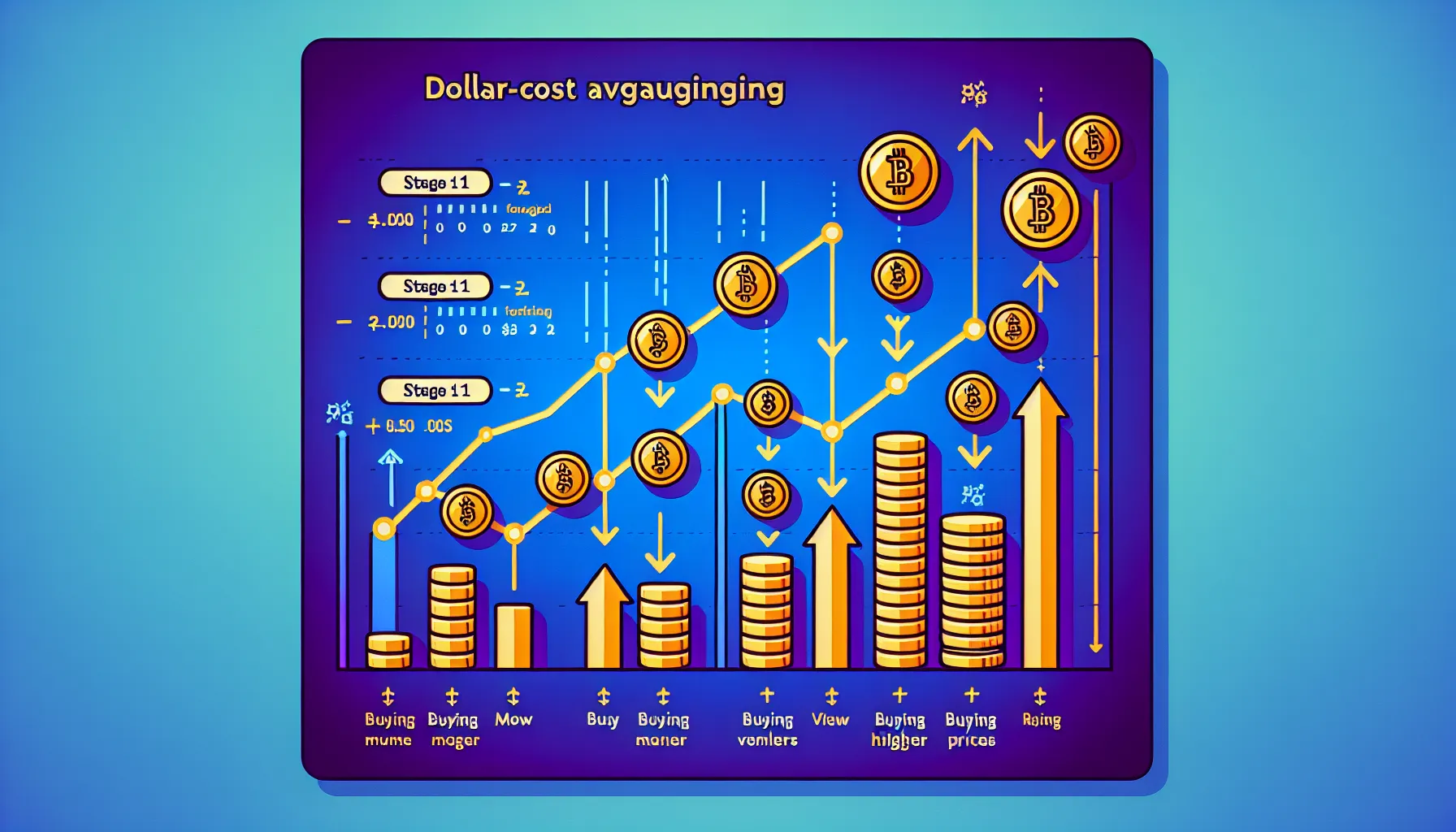
The beauty of DCA lies in its simplicity. Instead of agonising over whether today’s price is a bargain or a trap, an investor simply buys their allocated amount on their set schedule. Over weeks and months, this approach smooths out the average purchase price. When the market dips, their fixed investment buys more units of the cryptocurrency. When prices climb, they acquire fewer units. The result? A balanced average cost per unit that reflects a range of market conditions rather than a single moment in time.
This strategy directly counters one of the biggest pitfalls in crypto investing: the risk of going all-in at the worst possible moment. Imagine investing a large lump sum just before a major market correction, suddenly, you’re sitting on significant losses. DCA spreads that risk across multiple entry points, offering a cushion against the inevitable ups and downs of the crypto market.
Why Dollar-Cost Averaging Works for Cryptocurrency Investing
Cryptocurrency markets are among the most volatile asset classes in the world. Prices can swing by double-digit percentages in a single day, driven by everything from regulatory news and macroeconomic shifts to tweets from influential figures. For investors, this volatility presents both opportunity and danger. Dollar-cost averaging offers a practical way to navigate these turbulent waters without getting swept away by the currents.
The core advantage of DCA is that it strategically distributes risk. By investing at regular intervals, you’re not betting everything on a single price point. Instead, you’re acknowledging that predicting short-term price movements is extraordinarily difficult, even for seasoned traders, and choosing to participate in the market’s long-term potential instead. Over time, the mathematics of DCA work in your favour: you naturally accumulate more cryptocurrency when prices are lower and less when they’re higher, optimising your long-term position.
Reducing the Impact of Volatility
One of the most compelling reasons to use DCA in crypto is its ability to cushion the blow of volatility. Regular, fixed investments mean that sudden price drops or spikes have less impact on your overall portfolio. If Bitcoin crashes 20% one week, your scheduled purchase that week benefits from the lower price. If it surges the following month, you’ve already locked in some units at the previous, cheaper rate.
Research and historical analysis have shown that DCA minimises the risk of buying at an unfavourable moment. Rather than trying to time the market perfectly, a strategy that even professional fund managers struggle with, DCA accepts that some purchases will be at higher prices and others at lower ones. The average cost across all these purchases tends to land somewhere in the middle, providing a more stable foundation for long-term growth. This approach is particularly valuable in crypto, where a single day’s news can trigger dramatic price movements that might spook even experienced investors.
Removing Emotional Decision-Making
Human psychology is not well-suited to investing in volatile markets. Fear and greed drive impulsive decisions: panic selling during crashes, FOMO buying during rallies, and endless second-guessing in between. Dollar-cost averaging removes much of this emotional turmoil by automating the investment process.
When purchases happen automatically on a set schedule, there’s no room for last-minute hesitation or rash decisions based on the day’s headlines. This consistency is invaluable. Investors who stick to a DCA plan are less likely to abandon their strategy during downturns or chase pumps during euphoric bull runs. The discipline inherent in DCA encourages a long-term mindset, helping investors ride out the noise and focus on their broader financial goals. For many, the peace of mind that comes from not having to constantly monitor charts and news feeds is just as valuable as the financial benefits.
Setting Up Your Dollar-Cost Averaging Strategy
Getting started with dollar-cost averaging isn’t complicated, but it does require some upfront planning. The key is to establish a clear, sustainable framework that aligns with your financial situation and investment goals. A well-designed DCA strategy balances consistency with flexibility, allowing you to stay the course while adapting to changes in your life or the market.
The first step is deciding which cryptocurrencies you want to invest in and how much you can afford to allocate regularly. These decisions will shape your entire approach, so it’s worth taking the time to think them through carefully.
Determining Your Investment Amount and Frequency
Your investment amount should be realistic and sustainable. There’s no point committing to £500 per month if it strains your budget and forces you to skip payments or dip into emergency savings. A good rule of thumb is to choose an amount you can comfortably invest without affecting your day-to-day expenses or other financial priorities.
Frequency matters, too. Weekly purchases offer more granular averaging and can smooth out short-term volatility more effectively, but they also mean more transactions, and potentially more fees. Monthly investments are easier to manage and align well with most people’s income cycles, though they result in fewer data points for averaging. Fortnightly schedules offer a middle ground. Whatever frequency you choose, the most important factor is consistency. A DCA strategy only works if you stick with it through both bull and bear markets.
It’s also wise to start small if you’re new to crypto. You can always increase your investment amount as you become more comfortable with the market and your financial situation allows. The goal is to build a habit of regular investing, not to stretch yourself thin.
Choosing the Right Cryptocurrencies
Not all cryptocurrencies are created equal, and your choice of assets will significantly impact your DCA strategy’s success. For most investors, especially those new to crypto, focusing on established, high-market-cap coins like Bitcoin and Ethereum makes sense. These assets have proven track records, robust networks, and widespread adoption, making them relatively lower-risk options within the crypto space.
Bitcoin, as the original cryptocurrency and the most widely recognised digital asset, is often seen as “digital gold”, a store of value with long-term appreciation potential. Ethereum, with its smart contract functionality and ongoing network upgrades, offers exposure to the broader decentralised finance and Web3 ecosystem. Both have weathered multiple market cycles and continue to attract institutional interest.
That said, diversification can be part of a smart DCA approach. Investors with higher risk tolerance might allocate a portion of their regular purchases to promising altcoins or emerging projects. The key is to do your research: look into the project’s fundamentals, development activity, use cases, and market catalysts like upcoming upgrades or partnerships. Ethereum’s transition to proof-of-stake and its ongoing scalability improvements, for example, have been major drivers of investor interest.
Whatever mix you choose, be realistic about the risks. Smaller-cap cryptocurrencies can offer higher potential returns, but they also come with greater volatility and the possibility of project failure. A balanced approach, perhaps 70% in established assets and 30% in higher-risk opportunities, can offer growth potential without excessive exposure.
Selecting the Best Platform for Automated Purchases
Once you’ve settled on your investment amounts, frequency, and chosen cryptocurrencies, the next step is finding the right platform to execute your DCA strategy. Not all exchanges and brokers are equally suited to this approach, so it’s worth comparing your options carefully.
The ideal platform for dollar-cost averaging offers a recurring buy feature that allows you to automate your purchases. Many major crypto exchanges, such as Coinbase, Kraken, and Binance, provide this functionality, letting you set up weekly, fortnightly, or monthly purchases that execute automatically. This automation is crucial for maintaining discipline and ensuring you don’t miss scheduled investments.
Transaction fees are another critical consideration. Since DCA involves frequent, smaller purchases rather than occasional large ones, fees can add up quickly and erode your returns over time. Look for platforms with competitive fee structures, especially for recurring buys. Some exchanges offer reduced fees for users who hold their native tokens or meet certain trading volume thresholds, which might be worth exploring if you plan to use DCA long-term.
Security should never be an afterthought. Ensure the platform you choose has a solid reputation, robust security measures (like two-factor authentication and cold storage for most funds), and is properly regulated in your jurisdiction. Check reviews and community feedback to gauge reliability and customer service quality. The last thing you want is your carefully accumulated crypto holdings compromised by a platform security breach.
Also, consider the platform’s user interface and overall experience. If you’re going to be checking in periodically to monitor your portfolio and potentially adjust your strategy, a clean, intuitive interface makes the process much more pleasant. Some platforms also offer portfolio tracking tools, performance analytics, and educational resources that can help you make more informed decisions as you go.
Common Mistakes to Avoid When Dollar-Cost Averaging
Dollar-cost averaging is a relatively simple strategy, but that doesn’t mean it’s foolproof. There are several common pitfalls that can undermine its effectiveness, and being aware of them can help investors stay on track and maximise their results.
Overreacting to Market Movements
One of the biggest mistakes DCA investors make is abandoning their plan in response to dramatic market movements. When Bitcoin drops 30% in a week, the temptation to pause contributions or even sell existing holdings can be overwhelming. Conversely, during euphoric bull runs, investors might be tempted to increase their contributions dramatically or deviate from their schedule to “catch the wave.”
Both reactions defeat the purpose of dollar-cost averaging. The entire point of DCA is to remove emotional decision-making from the equation and maintain consistency regardless of market conditions. In fact, market downturns are when DCA truly shines, your regular investments buy more units at depressed prices, setting you up for greater gains when the market recovers. Staying disciplined during volatility is what separates successful DCA investors from those who abandon the strategy at the worst possible time.
It helps to remind yourself why you chose DCA in the first place: to avoid the stress and risk of market timing. If you find yourself constantly second-guessing your strategy based on daily price movements, it might be worth stepping back from the charts and focusing on your long-term goals instead.
Neglecting Transaction Fees
Transaction fees might seem trivial on individual purchases, but they can become a significant drag on returns when you’re making frequent, regular investments. If you’re paying 2-3% in fees on every weekly purchase, that’s money that could otherwise be working for you in the market.
Before committing to a DCA strategy on a particular platform, calculate the total fees you’ll pay over a year. Compare different exchanges and their fee structures, and don’t overlook smaller details like withdrawal fees, network fees for transferring crypto, and any hidden charges. Some platforms offer fee discounts for recurring purchases or loyalty programmes that reduce costs over time.
If fees are eating into your returns, consider adjusting your frequency. Moving from weekly to fortnightly or monthly purchases can halve or quarter your transaction costs without fundamentally changing the benefits of dollar-cost averaging. The key is finding a balance between frequent averaging and cost efficiency.
Tracking and Adjusting Your Strategy Over Time
Dollar-cost averaging isn’t a “set it and forget it” strategy, at least not entirely. Whilst the beauty of DCA lies in its automation and consistency, successful investors periodically review their approach to ensure it still aligns with their goals and the evolving market landscape.
Most platforms provide portfolio tracking tools that show your total investment, current holdings, average purchase price, and overall performance. Make it a habit to check in on these metrics monthly or quarterly, not to obsess over short-term gains and losses, but to maintain awareness of your progress and spot any issues early. Are your contributions being executed as scheduled? Have fees increased unexpectedly? Is your chosen cryptocurrency still a solid long-term bet, or have fundamentals changed?
Life circumstances change, too. You might receive a salary increase that allows you to invest more, or unexpected expenses might require you to temporarily reduce contributions. Your DCA strategy should be flexible enough to accommodate these changes. There’s no shame in adjusting your investment amount, what matters is maintaining the habit of regular investing within your means.
Market conditions and your investment thesis might also evolve. Perhaps Ethereum’s upgrades have progressed faster than expected, justifying a larger allocation. Or maybe a new cryptocurrency has emerged with compelling use cases worth adding to your mix. Periodic strategy reviews give you the opportunity to make these adjustments thoughtfully rather than impulsively.
That said, be cautious about making too many changes too quickly. The power of DCA comes from consistency over time, not from constantly tweaking your approach. Aim for a balance: stay informed and flexible, but don’t let minor market fluctuations or momentary doubts derail a fundamentally sound long-term strategy.
Conclusion
Dollar-cost averaging offers crypto investors a disciplined, stress-reducing path to building wealth in one of the world’s most volatile markets. By committing to regular, fixed investments regardless of price, investors can smooth out the impact of market swings, remove the emotional burden of timing decisions, and position themselves for long-term growth without the constant anxiety that comes with trying to predict the next big move.
The smart way to carry out DCA is to start with a clear plan: choose your investment amount and frequency based on what’s sustainable for your budget, focus on established cryptocurrencies whilst allowing room for calculated diversification, and select a reliable platform with low fees and strong security. Avoid common pitfalls like abandoning your strategy during downturns or letting transaction costs erode your returns, and make time to periodically review and adjust your approach as your circumstances and the market evolve.
Eventually, dollar-cost averaging isn’t about getting rich overnight or perfectly timing the market, it’s about steady, patient accumulation and letting time work in your favour. For those willing to commit to the process, DCA can transform the chaotic world of crypto investing into a manageable, even rewarding, long-term journey.
Frequently Asked Questions
What is dollar-cost averaging in cryptocurrency investing?
Dollar-cost averaging (DCA) in crypto involves investing a fixed amount into cryptocurrencies at regular intervals—weekly, fortnightly, or monthly—regardless of market price. This strategy smooths out your average purchase price over time, reducing the risk of investing everything at an unfavourable moment.
How does dollar-cost averaging reduce the impact of crypto volatility?
DCA cushions volatility by spreading purchases across multiple entry points. When prices drop, your fixed investment buys more units; when prices rise, you acquire fewer. This natural balancing means sudden market swings have less impact on your overall portfolio position.
Should I dollar-cost average into Bitcoin or Ethereum?
Both Bitcoin and Ethereum are excellent choices for DCA strategies due to their established track records and market dominance. Bitcoin offers digital gold characteristics, whilst Ethereum provides exposure to DeFi and Web3. Many investors allocate to both for balanced exposure.
What’s the best frequency for dollar-cost averaging into crypto?
Weekly purchases offer more granular price averaging but incur more transaction fees. Monthly investments align with income cycles and reduce costs. Fortnightly schedules provide a middle ground. The most important factor is choosing a sustainable frequency you can maintain consistently.
Can you lose money with dollar-cost averaging in cryptocurrency?
Yes, DCA doesn’t guarantee profits or eliminate losses. If crypto prices decline and don’t recover, you’ll still experience losses. However, DCA reduces the risk of catastrophic losses from poorly timed lump-sum investments and historically performs well in volatile markets over longer periods.
How much should I invest when dollar-cost averaging into crypto?
Invest an amount you can comfortably afford without affecting daily expenses or emergency savings. Start small if you’re new to crypto, perhaps £50–£100 monthly, and increase as your financial situation allows. Consistency matters more than the specific amount invested.