Cryptocurrency markets are notorious for their dramatic price swings, one moment surging on optimism, the next plunging into freefall. These massive sell-offs aren’t random: they’re triggered by specific events and conditions that shake investor confidence to its core. Understanding what sparks these market-wide panics is essential for anyone navigating the volatile world of digital assets.
From regulatory bombshells to security breaches that expose billions in vulnerabilities, the catalysts for crypto carnage are varied and often interconnected. Some triggers emerge from outside the crypto ecosystem, macroeconomic shifts or central bank decisions, whilst others arise from within, such as technical failures or deliberate actions by large holders. Each catalyst carries the potential to unleash cascading waves of selling that ripple across global markets within minutes.
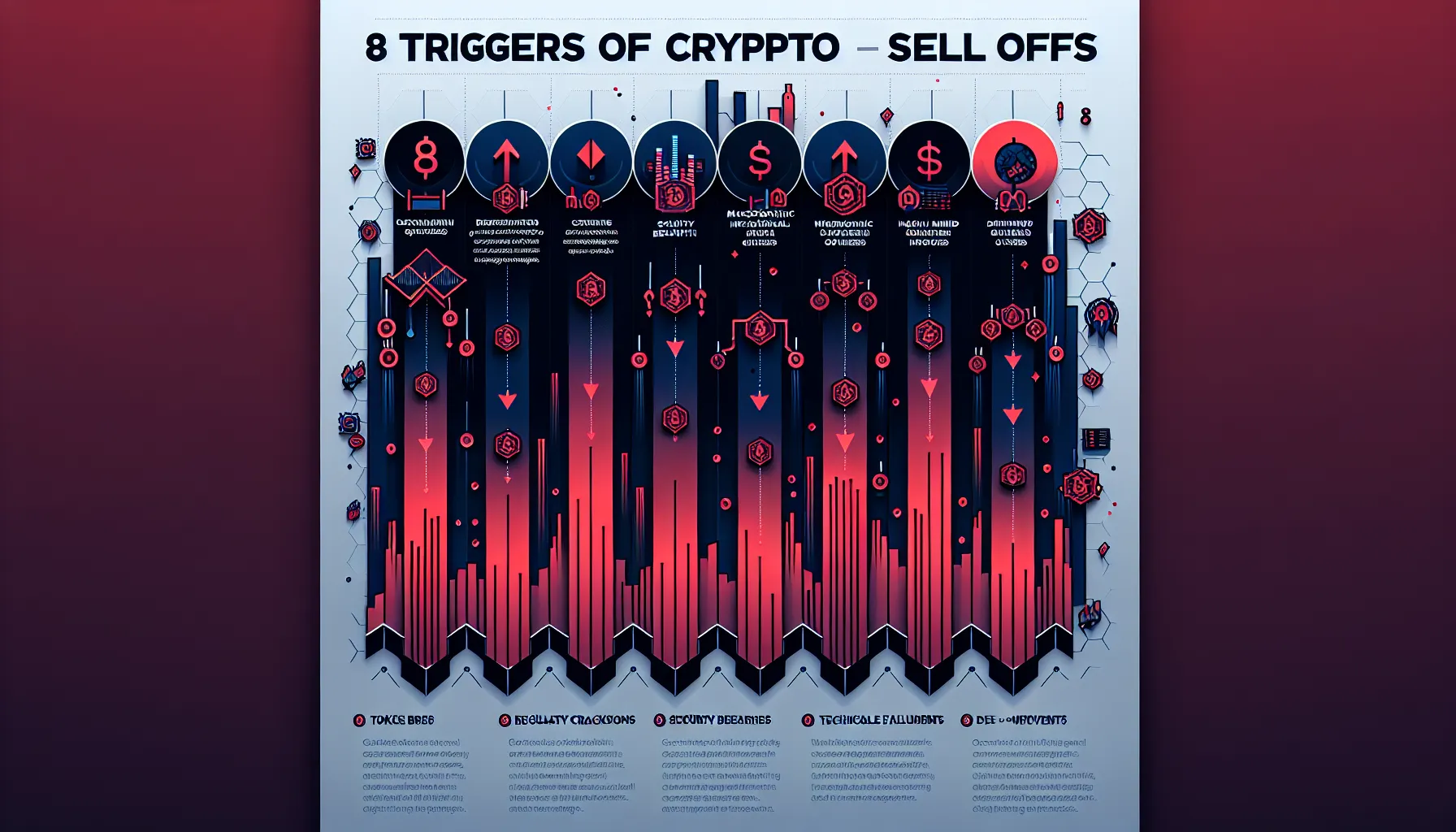
This article examines eight critical triggers that have historically prompted massive cryptocurrency sell-offs, providing insight into the mechanisms behind market panic and the vulnerabilities that continue to shape digital asset trading.
Key Takeaways
- Massive crypto sell-offs are triggered by eight critical factors: regulatory crackdowns, security breaches, macroeconomic shifts, token unlocks, negative media coverage, technical failures, whale movements, and stablecoin de-pegging events.
- Security breaches remain an existential threat, with nearly £1.93 billion stolen in crypto-related crimes during the first half of 2025 alone, eroding investor confidence across entire markets.
- Interest rate increases by central banks fundamentally alter risk-reward calculations, driving capital away from cryptocurrency towards safer fixed-income securities with competitive returns.
- Whale movements and large-scale liquidations create cascading sell-offs, as concentrated cryptocurrency holdings allow relatively few addresses to trigger disproportionate market reactions.
- Stablecoin de-pegging events create systemic risks that ripple through DeFi protocols, forcing collateralised position liquidations and triggering widespread market panic.
- Understanding what triggers massive crypto sell-offs is essential for comprehensive risk management in markets that operate 24/7 and can experience dramatic price swings within minutes.
Regulatory Crackdowns and Legal Uncertainty

Few things spook cryptocurrency investors quite like the prospect of regulatory intervention. When governments announce restrictions, introduce licensing requirements, or launch enforcement actions against prominent exchanges, the market response is often swift and brutal. Regulatory uncertainty directly undermines the confidence traders need to maintain positions in inherently volatile assets.
The challenge stems from cryptocurrency’s borderless nature colliding with nation-state regulatory frameworks. Legal ambiguity surrounding cryptocurrency classification, whether as commodities, securities, or currencies, creates operational headaches and compliance nightmares. Tax treatment, anti-money laundering requirements, and operational constraints vary wildly between jurisdictions, making it difficult for exchanges and investors to navigate safely.
What makes regulatory triggers particularly potent is their cascading effect. When major economies like the United States, European Union, or United Kingdom announce significant policy shifts, the impact reverberates globally. A crackdown in one jurisdiction prompts traders worldwide to reassess their risk exposure, often concluding that discretion is the better part of valour. This collective retreat to safety transforms isolated regulatory actions into market-wide sell-offs.
Enforcement actions against specific exchanges or projects serve as stark reminders of cryptocurrency’s legal precariousness. When regulators fine platforms or force operational changes, investors question whether their holdings might face similar scrutiny. This uncertainty alone can trigger mass exits, as traders prefer to liquidate positions rather than risk being caught in future regulatory crosshairs.
Exchange Hacks and Security Breaches
Security breaches represent one of the most devastating catalysts for cryptocurrency sell-offs. When exchanges, the custodians of billions in digital assets, suffer hacks, the resulting panic extends far beyond the affected platform. These incidents strike at the fundamental promise of cryptocurrency security and erode confidence across the entire market.
The numbers tell a sobering story. Nearly £1.93 billion was stolen in crypto-related crimes during the first half of 2025 alone, demonstrating that security vulnerabilities remain an existential threat to the industry. Individual breaches can be catastrophic: the Ronin Network hack in March 2022 resulted in $615 million in stolen assets, whilst the Poly Network breach in August 2021 saw $611 million compromised.
More recently, CoinDCX experienced a $44.2 million security breach on 19 July 2025, targeting operational accounts and highlighting ongoing vulnerabilities in exchange infrastructure. When such breaches occur, the immediate response is predictable: mass withdrawals as users rush to move assets off potentially compromised platforms.
The psychological impact extends beyond the hacked exchange. Investors begin questioning whether their chosen platforms are equally vulnerable, triggering precautionary withdrawals and position liquidations. This collective loss of confidence creates selling pressure that depresses prices across multiple cryptocurrencies, regardless of their connection to the breached platform. Exchange outages during these critical periods only compound the problem, as trapped investors liquidate positions immediately upon regaining access, further exacerbating price declines.
Macroeconomic Shifts and Interest Rate Changes
Cryptocurrency doesn’t exist in a vacuum, it competes for capital against traditional asset classes. When macroeconomic conditions shift, particularly about interest rates, cryptocurrency often finds itself on the losing end of investor reallocation decisions.
Central bank interest rate increases fundamentally alter the risk-reward calculation for speculative assets. Higher rates make fixed-income securities more attractive, offering safer returns without the volatility inherent in cryptocurrency markets. As central banks tighten monetary policy, capital flows away from risk assets like cryptocurrency toward bonds and savings instruments that suddenly offer competitive returns with far less downside risk.
Inflation concerns create additional complexity. Whilst some cryptocurrency advocates position digital assets as inflation hedges, market behaviour tells a different story. When inflation data surprises to the upside, traders often anticipate more aggressive central bank responses, triggering preemptive selling in cryptocurrency markets. Similarly, recessionary signals prompt investors to reduce exposure to speculative positions, favouring cash and defensive assets instead.
Economic data releases, employment figures, GDP reports, inflation numbers, can spark immediate cryptocurrency sell-offs as markets reprice risk premiums in real-time. The interconnection between traditional finance and cryptocurrency markets has strengthened considerably, meaning macroeconomic shifts that once had minimal impact now routinely trigger significant digital asset volatility. Cryptocurrency’s correlation with tech stocks and other risk assets means it often sells off alongside broader market declines driven by macroeconomic concerns.
Major Token Unlocks and Insider Selling
Token unlocks represent a predictable yet powerful catalyst for cryptocurrency sell-offs. These scheduled events release previously locked tokens into circulation, dramatically increasing available supply at predetermined times. When project founders, venture capital investors, or early backers suddenly gain access to substantial token holdings, selling pressure typically follows.
The mechanics are straightforward but consequential. Many cryptocurrency projects distribute tokens to early investors, team members, and advisors with lockup periods preventing immediate sales. These restrictions exist to align long-term incentives and prevent immediate dumping. But, when lockup periods expire, large quantities of tokens flood the market simultaneously.
The challenge is one of supply and demand. Unless organic buying demand increases proportionally to absorb the newly circulating tokens, prices inevitably decline under the selling pressure. Early investors who acquired tokens at substantial discounts have strong incentives to realise profits, particularly if they’ve waited months or years for unlock events.
Market participants closely monitor unlock schedules, often positioning themselves ahead of known events. This creates a self-fulfilling prophecy: anticipation of selling pressure prompts preemptive exits, which themselves depress prices before the actual unlock occurs. When the tokens finally release, the anticipated selling materialises, validating the earlier concerns and extending the downward price movement.
Insider selling, whether through scheduled unlocks or discretionary disposals, sends negative signals to retail investors. If those closest to a project, those with the most information about its prospects, are selling, it raises uncomfortable questions about future value.
Negative Media Coverage and Market Sentiment
Media narratives wield enormous influence over cryptocurrency markets, particularly amongst retail investors who rely on news coverage to inform trading decisions. Adverse journalism exposing fraud, mismanagement, or regulatory violations can trigger panic selling that transforms isolated incidents into market-wide contagion.
The FTX collapse in November 2022 stands as perhaps the most damaging media event in cryptocurrency history. The unravelling of what was once considered a reputable exchange, culminating in $600 million being stolen and revelations of systematic mismanagement, didn’t just destroy FTX, it triggered broader market selling as investors questioned which other platforms might harbour similar problems.
Investigative journalism serves an important watchdog function, but the market response to exposés can be indiscriminate. When media outlets publish damaging reports about specific projects or exchanges, the resulting sentiment shift often affects the entire cryptocurrency market. Retail investors, lacking the resources for independent due diligence, frequently adopt a “sell first, ask questions later” approach when confronted with negative headlines.
Social media amplifies these effects dramatically. A critical tweet from an influential figure, a viral exposé, or coordinated negative commentary can spark selling waves within minutes. The 24/7 nature of cryptocurrency markets means there’s no circuit breaker, no closing bell to pause trading and allow cooler heads to prevail. Negative sentiment spreads at digital speed, triggering automated sell orders and panic liquidations before many investors even understand what’s happening.
The psychological dimension matters enormously. Cryptocurrency markets are heavily driven by sentiment and speculation rather than fundamental valuation metrics. When sentiment sours, whether due to legitimate concerns or exaggerated fears, the selling response can far exceed what fundamentals alone might justify.
Technical Failures and Network Outages
Technical reliability is foundational to cryptocurrency’s value proposition. When blockchain networks suffer outages, smart contracts fail, or exchanges experience technical issues, the immediate market response is often severe selling pressure. These failures undermine confidence in the technology itself, not just individual platforms.
Network outages are particularly damaging because they expose cryptocurrency’s reliance on functioning infrastructure. When a blockchain becomes inaccessible or transactions fail to process, the purported advantages over traditional financial systems evaporate. Users expecting 24/7 availability and instant settlements find themselves locked out, unable to access their assets precisely when they might need to most.
Exchange technical issues during volatile trading periods create especially problematic scenarios. When platforms become inaccessible during price swings, trapped investors cannot manage positions or carry out stop-losses. The frustration and financial losses accumulate. Once technical issues resolve and access is restored, pent-up selling pressure is released all at once, exacerbating price movements and creating cascading volatility.
Smart contract failures in decentralised finance protocols can trigger systemic issues. Bugs or exploits that drain liquidity pools or freeze assets create immediate panic amongst users of affected protocols. The interconnected nature of DeFi means failures in one protocol can cascade through others, as collateralised positions liquidate and liquidity dries up across multiple platforms simultaneously.
These technical triggers are particularly concerning because they strike at cryptocurrency’s core promise: reliable, decentralised, always-available financial infrastructure. Each failure chips away at that promise, making investors question whether the technology is truly ready for mainstream adoption.
Whale Movements and Large-Scale Liquidations
Large cryptocurrency holders, colloquially known as whales, wield disproportionate influence over market prices. When these major players initiate substantial transactions, particularly transfers to exchanges or large sell orders, markets react swiftly and often dramatically.
The concentration of cryptocurrency holdings means relatively few addresses control substantial portions of circulating supply for many digital assets. When whales move coins, blockchain transparency allows market participants to observe these transactions in real-time. Transfers from private wallets to exchange addresses are typically interpreted as preparation for selling, prompting preemptive exits by smaller holders hoping to front-run the anticipated sell pressure.
The psychology is straightforward: if someone holding millions in cryptocurrency is selling, they presumably know something or have reached conclusions about future price direction. Retail investors, lacking insider information, often assume whales possess superior knowledge and follow their lead. This creates herding behaviour where whale movements trigger disproportionate market responses.
Leveraged positions add explosive potential to whale-triggered sell-offs. Forced liquidations from margin calls create cascading effects. When prices decline sufficiently to trigger liquidations, the automatic selling of collateralised positions drives prices lower still, triggering additional liquidations in a self-reinforcing cycle. A single whale’s large sell order can initiate this cascade, with automated systems amplifying the initial move into a market-wide rout.
The lack of market depth in many cryptocurrency trading pairs means large orders move prices significantly. Unlike traditional equity markets with substantial institutional market-making and deep order books, cryptocurrency markets remain relatively thin. Whale transactions hence create outsized price impacts, particularly during periods of lower liquidity when even moderately sized orders can swing prices dramatically.
Stablecoin De-Pegging Events
Stablecoins serve as the financial plumbing of cryptocurrency markets, providing a supposedly stable store of value pegged to fiat currencies like the US dollar. When these pegs break, when stablecoins trade significantly above or below their intended $1.00 value, systemic risks emerge that can trigger widespread market panic.
De-pegging events are particularly dangerous because stablecoins underpin enormous volumes of trading activity and serve as collateral across decentralised finance protocols. When confidence in a stablecoin’s peg erodes, holders rush to exit, creating selling pressure that pushes the asset further from its peg in a self-reinforcing spiral.
The contagion effects extend far beyond the affected stablecoin itself. Collateralised debt positions using the de-pegged stablecoin face liquidation as collateral values collapse. DeFi protocols relying on that stablecoin for liquidity or as a pricing reference experience cascading failures. Traders using the stablecoin as a safe haven during volatility find themselves holding a depreciating asset, forcing liquidations into other cryptocurrencies or fiat currencies.
Historically, major de-pegging events have triggered broader market sell-offs as investors question the stability of the entire cryptocurrency infrastructure. If the assets designed specifically for stability can’t maintain their pegs, what confidence can traders have in more volatile cryptocurrencies? This loss of confidence translates directly into selling pressure across the market.
The challenge is that stablecoin mechanisms vary, some use fiat reserves, others algorithmic mechanisms, still others crypto-collateralisation. When one category experiences de-pegging, investors often flee all stablecoins indiscriminately, creating liquidity crunches and forcing position closures that amplify broader market declines. The interconnected nature of cryptocurrency markets means stablecoin instability creates systemic vulnerabilities that can rapidly transform into market-wide sell-offs.
Conclusion
Cryptocurrency markets remain extraordinarily responsive to a diverse array of triggers, from regulatory announcements to technical failures, from macroeconomic shifts to the actions of individual large holders. These eight catalysts, regulatory crackdowns, security breaches, interest rate changes, token unlocks, negative media, technical failures, whale movements, and stablecoin de-pegging, rarely operate in isolation. More often, they combine and amplify one another, transforming isolated incidents into market-wide panics.
The security dimension deserves particular attention. With nearly £1.93 billion stolen in crypto-related crimes during just the first half of 2025, exchange and protocol security remains an existential challenge for the industry. Each breach doesn’t merely represent financial losses: it erodes the confidence essential for sustained market participation.
For investors navigating these turbulent markets, understanding these triggers isn’t about prediction, it’s about preparation. Comprehensive risk management strategies must acknowledge the multiple pathways through which sell-offs can emerge and intensify. The cryptocurrency market’s 24/7 nature, combined with its susceptibility to sentiment shifts and technical vulnerabilities, creates an environment where massive sell-offs can materialise with frightening speed.
As the cryptocurrency ecosystem matures, some triggers may diminish in potency whilst new ones emerge. Regulatory frameworks will evolve, security practices will improve, and market depth will increase. Yet the fundamental volatility driven by these diverse catalysts seems likely to persist, making awareness and risk management essential for anyone participating in digital asset markets.