The cryptocurrency market offers incredible opportunities, but it’s also littered with traps that ensnare even experienced investors. Whilst the allure of exponential gains attracts millions globally, the same characteristics that make crypto appealing, decentralisation, anonymity, and rapid innovation, also create fertile ground for scams and fraudulent schemes.
According to City of London Police data, more than £612 million was lost to investment fraud in 2023, with cryptocurrency accounting for over 40% of investment scam reports. These staggering figures reveal an uncomfortable truth: countless investors ignore warning signs until their capital vanishes. Understanding these red flags isn’t just helpful, it’s essential for protecting one’s financial future in the volatile crypto landscape.
Key Takeaways
- Over £612 million was lost to investment fraud in 2023, with cryptocurrency accounting for over 40% of scam reports, highlighting the critical importance of recognising crypto red flags.
- Guaranteed returns of 10%, 50%, or 100% monthly are a major crypto red flag, as no legitimate investment can promise such outcomes in volatile markets.
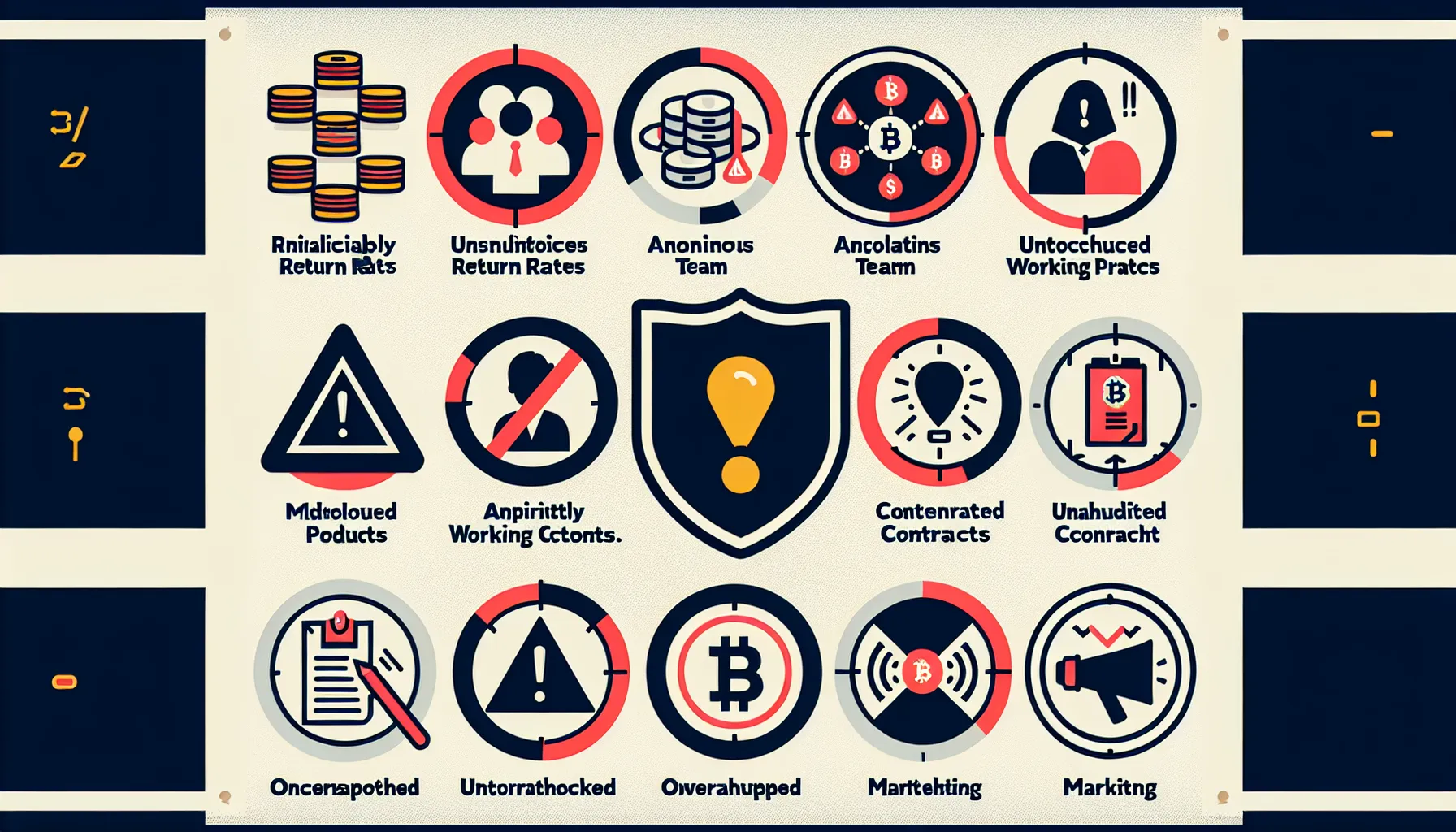
- Anonymous team members, lack of working products, and unaudited smart contracts indicate high-risk projects that often collapse or enable fund theft.
- High-pressure tactics demanding immediate investment and recruitment-focused incentives structurally resemble pyramid schemes rather than genuine blockchain projects.
- Healthy projects demonstrate financial transparency, encourage open community dialogue, and balance marketing with technical development rather than relying solely on hype.
- Conducting comprehensive due diligence—including team verification, tokenomics analysis, and community assessment—protects investors from the majority of crypto scams.
Unrealistic Promises of Guaranteed Returns
When a crypto project promises guaranteed returns of 10%, 50%, or even 100% monthly, alarm bells should ring immediately. These pledges exploit fundamental human greed, presenting extraordinary returns within unrealistically short timeframes. Yet basic investment principles make clear that no legitimate investment vehicle can guarantee such outcomes, especially in crypto’s notoriously volatile markets.
The maths rarely adds up. If a project genuinely possessed a method to generate consistent triple-digit annual returns, institutional investors would queue up with billions in capital. The fact that they’re targeting retail investors through aggressive social media campaigns should raise immediate suspicion.
Crypto scams frequently package these promises in sophisticated technical jargon, making outlandish claims sound plausible to those unfamiliar with blockchain fundamentals. They might reference “proprietary trading algorithms,” “arbitrage bots,” or “yield farming strategies” without providing verifiable evidence these mechanisms actually function.
Legitimate DeFi protocols do offer yield opportunities, but they come with transparent risk disclosures, fluctuating rates tied to market conditions, and clear explanations of how returns are generated. Any project guaranteeing fixed, extraordinary returns lacks realistic financial grounding and should trigger immediate scepticism.
Anonymous or Unverifiable Team Members
Legitimate blockchain projects maintain transparent, verifiable teams with professional credentials that investors can independently confirm. When developers hide behind pseudonyms, use stock photos, or present profiles that don’t check out on LinkedIn, the project carries significant risk.
True, Bitcoin’s Satoshi Nakamoto remains anonymous, but that’s a historical exception rather than a rule modern projects should follow. Today’s regulatory environment and investor expectations demand accountability. Established projects feature team members with verifiable backgrounds, previous successful ventures, industry recognition, and public presence at conferences or in technical communities.
Inability to verify credentials signals potential fraudulent intent. Scammers understand that anonymity provides escape routes when schemes collapse. They create convincing facades, professional headshots, impressive (but fabricated) CVs, even fake social media profiles, designed to instil false confidence.
Before investing, savvy participants cross-reference team members across multiple platforms. They look for GitHub contributions, speaking engagements, published research, or involvement in other recognised projects. If team members exist only within the project’s own promotional materials, that’s a massive red flag indicating the entire venture might be built on deception.
Lack of Clear Use Case or Whitepaper
A whitepaper serves as a project’s technical and philosophical foundation, explaining its purpose, technology, differentiation, and roadmap. Poorly written, plagiarised, or non-existent whitepapers signal serious concerns about a project’s legitimacy and substance.
Genuine projects provide comprehensive documentation that technical readers can evaluate critically. These documents detail the problem being solved, the proposed solution’s mechanics, tokenomics, development timeline, and competitive advantages. They acknowledge challenges and limitations rather than presenting utopian visions devoid of nuance.
When whitepapers consist primarily of buzzwords strung together without coherent technical explanation, investors should recognise this as evidence the project lacks legitimate development foundations. Vague promises about “revolutionising finance” or “disrupting industries” without specific implementation details suggest the team either doesn’t understand blockchain technology or deliberately obscures their actual intentions.
Absence of documentation proves even more damning. Projects asking for investment without explaining what they’re building demonstrate contempt for due diligence. Compare this to established projects like Ethereum, Polkadot, or Chainlink, whose extensive technical documentation allows developers and investors to thoroughly evaluate their approaches before committing resources.
Pressure to Recruit Others or Invest Quickly
High-pressure tactics demanding immediate investment decisions rank among the most reliable scam indicators. Legitimate projects allow, indeed, encourage, investors to conduct thorough due diligence. They understand that informed participants create healthier, more sustainable communities.
When projects create artificial urgency through countdown timers, limited-time bonuses, or claims that “this opportunity won’t last,” they’re employing psychological manipulation rather than presenting genuine value propositions. These tactics exploit fear of missing out (FOMO), short-circuiting the rational evaluation process that protects investors from poor decisions.
Recruitment-focused incentives present another warning sign. Projects offering substantial rewards for bringing in new investors structurally resemble pyramid schemes rather than genuine utility tokens. In these models, early participants profit primarily from recruiting others rather than from any underlying product or service creating real value.
Legitimate blockchain projects focus on building technology and fostering organic adoption. They might offer referral programmes, but these represent minor aspects of broader ecosystems rather than core business models. When recruitment becomes the primary activity and revenue source, the project inevitably collapses once new investor inflows slow, leaving late participants holding worthless tokens.
No Working Product or Open-Source Code
Projects without functional products or publicly available source code remain purely theoretical propositions. Whilst early-stage ventures naturally operate in development phases, the complete absence of demonstrable progress, especially combined with active fundraising, suggests vaporware designed purely for speculation.
Established crypto projects demonstrate operational technology that users can interact with, test, and evaluate. Open-source code allows developers to audit functionality, identify vulnerabilities, and verify that promised features actually exist. Transparency builds confidence and enables community contributions that strengthen projects over time.
When teams refuse to share code, citing “competitive advantages” or “proprietary technology” whilst simultaneously soliciting investment, scepticism becomes warranted. In blockchain’s collaborative ecosystem, legitimate innovators understand that open development fosters trust, accelerates debugging, and attracts talent.
Before investing, participants should ask: Can I use this product today? Does the code exist in public repositories? Have independent developers reviewed and contributed to it? If answers remain negative months or years into a project’s existence, the venture likely lacks substance. Real builders ship code: scammers ship promises wrapped in marketing materials.
Suspicious Tokenomics and Concentrated Ownership
Token distribution structures reveal much about a project’s intentions and sustainability. Concentrated ownership among founders, early investors, or development teams creates massive dumping risks when prices rise, enabling insiders to extract value whilst leaving retail investors holding devalued assets.
Examine allocation carefully. Does the team control 40%, 50%, or more of total supply? Are tokens released gradually through vesting schedules, or can insiders dump holdings immediately? Transparent projects carry out multi-year vesting periods preventing founders from cashing out before delivering value.
Artificially inflated prices combined with concentrated holdings create classic pump-and-dump scenarios. Insiders generate hype through marketing, driving retail purchases that elevate valuations. Once prices reach targets, they systematically sell holdings, triggering price collapses that devastate latecomers.
Why Token Distribution Matters
Unequal distribution enables price manipulation. When small groups control significant percentages of circulating supply, they can coordinate buying or selling to move markets artificially. Projects should feature distributed ownership preventing individual actors from dictating price movements or implementing coordinated exits.
Healthy tokenomics balance various stakeholders, development teams, early supporters, community members, and ecosystems reserves, through transparent allocation preventing any single group from wielding disproportionate power. Red flags include hidden allocations, unclear distribution charts, or refusal to disclose holdings. Before investing, demand clarity about who owns what and when those tokens become tradeable.
Unaudited Smart Contracts
Smart contracts govern token behaviour, fund management, and protocol operations. Unaudited contracts can hide vulnerabilities, backdoors, or malicious functions enabling developers to drain funds, mint unlimited tokens, or manipulate mechanics in ways that devastate investors.
Legitimate projects undergo independent security audits from reputable firms like CertiK, Trail of Bits, or OpenZeppelin. These audits identify vulnerabilities before deployment, providing assurance against exploits. Published audit reports demonstrate transparency and commitment to security, allowing technically proficient community members to review findings.
When projects launch without audits, or worse, refuse to share audit results, they’re asking investors to trust blindly. Given crypto’s immutable nature, vulnerabilities in deployed contracts often prove irreversible. Numerous high-profile hacks have drained hundreds of millions from protocols with flawed smart contract security.
Before investing, verify that contracts have been audited and review those reports personally (or consult technically skilled advisers who can). Look for critical or high-severity findings and assess how teams addressed them. Projects dismissing audit importance or claiming audits are “unnecessary expenses” reveal dangerous attitudes toward security that eventually endanger investor capital.
Overhyped Marketing with Little Substance
Excessive social media promotion combined with minimal technical development indicates manipulation rather than genuine innovation. When projects invest more resources in influencer partnerships, paid promotions, and hype generation than in actual building, their priorities become clear, and those priorities don’t align with investor interests.
Sudden advertising surges across Twitter, YouTube, and Telegram frequently precede orchestrated price pumps. Projects coordinate marketing campaigns to create FOMO, driving retail purchases that elevate prices temporarily. Once targets are reached, insiders exit positions, leaving organic investors with losses.
Legitimate projects certainly engage in marketing, but they balance promotion with transparent development updates, technical milestones, and community education. Their communications focus on explaining technology, showcasing progress, and fostering genuine adoption rather than simply hyping token prices.
Red flags include celebrity endorsements without disclosed compensation, suspiciously enthusiastic influencer coverage across multiple channels simultaneously, aggressive paid advertising even though lack of working products, and communities focused exclusively on price speculation rather than technology discussion. When marketing noise drowns out technical signal, investors should recognise they’re being targeted by sophisticated promotional campaigns designed to extract capital rather than create value.
Lack of Transparency Around Finances
Projects refusing to disclose fund allocations, development budgets, or operational costs warrant extreme caution. Financial transparency builds investor confidence by demonstrating that raised capital funds legitimate development rather than disappearing into founders’ pockets.
Legitimate projects maintain public treasuries with on-chain transparency, publish regular financial reports detailing expenditures, and carry out governance mechanisms allowing token holders to influence fund allocation. This openness proves they’re managing resources responsibly toward stated objectives.
When teams deflect questions about finances, claim information is “commercially sensitive,” or provide vague assurances without specifics, they’re likely mismanaging or misappropriating funds. The blockchain’s transparent nature makes financial secrecy particularly suspicious, projects built on transparent technology should embrace financial openness.
Before investing, examine whether projects disclose: how much capital they’ve raised, where those funds reside, how they’re being spent, what runway remains, and what financial controls prevent misuse. Projects treating investor capital as personal slush funds inevitably collapse when money runs out, leaving token holders with worthless assets and no recourse.
Community Warning Signs and Censorship
Communities aggressively suppressing criticism, banning dissenting voices, or controlling discussions exhibit concerning cultish behaviours that signal deeper problems. Healthy projects encourage open dialogue, welcome constructive criticism, and address legitimate concerns directly rather than silencing questioners.
When moderators delete negative comments, ban users asking difficult questions, or create echo chambers where only positive sentiment is permitted, they’re hiding uncomfortable truths. Legitimate projects recognise that critical feedback identifies weaknesses, improves development, and builds stronger communities through honest engagement.
Suspicious community behaviours include: coordinated attacks on critics, dismissing concerns as “FUD” (fear, uncertainty, doubt) without addressing substance, cult-like devotion to founders, intolerance toward competing projects, and aggressive recruitment tactics pressuring members to promote tokens constantly.
Before investing, spend time in project communities observing dynamics. Are difficult questions answered thoughtfully or deflected? Do long-term members express genuine enthusiasm for technology or just price speculation? Can people voice concerns without facing hostility? Communities reflecting genuine projects foster inclusive, technically substantive discussions. Those masking scams create hostile environments designed to suppress information that might dissuade new investors from buying tokens that enrich insiders.
Conclusion
These red flags collectively paint a picture of potential scams, manipulative projects, or ventures destined for failure. Whilst no single warning sign definitively proves fraud, multiple indicators appearing together warrant extreme caution, or outright avoidance.
The cryptocurrency space rewards diligence and punishes complacency. As the £612 million lost to investment fraud in 2023 demonstrates, ignoring warning signs carries devastating financial consequences. Comprehensive due diligence encompassing team verification, technical audits, transparent tokenomics, functional products, and community health assessment remains essential before committing capital.
Investors who take time to evaluate projects critically, demand transparency, and walk away from suspicious opportunities protect themselves from the majority of crypto scams. The market offers legitimate innovations creating genuine value, but identifying them requires looking beyond hype to examine fundamentals, governance, and intentions.
Eventually, if something feels wrong, it probably is. Trust instincts, prioritise capital preservation over FOMO, and remember that missing one opportunity matters far less than losing everything to a scam. The best investment decisions often involve projects one doesn’t buy.
Frequently Asked Questions
What are the most common crypto red flags that investors should watch for?
Key crypto red flags include unrealistic guaranteed returns, anonymous team members, lack of whitepaper or working product, high-pressure recruitment tactics, unaudited smart contracts, and concentrated token ownership. Multiple warning signs appearing together warrant extreme caution or complete avoidance.
How can I verify if a crypto project team is legitimate?
Cross-reference team members across LinkedIn, GitHub, industry conferences, and published research. Look for verifiable professional backgrounds, previous successful ventures, and public presence in technical communities. If profiles exist only in promotional materials, consider it a major red flag.
Why are smart contract audits important before investing in crypto?
Unaudited smart contracts can contain vulnerabilities, backdoors, or malicious functions enabling developers to drain funds or manipulate token mechanics. Independent audits from reputable firms like CertiK identify security flaws before deployment, protecting investors from exploits and irreversible losses.
What is a crypto pump and dump scheme?
A pump and dump occurs when insiders generate hype through aggressive marketing to drive retail purchases, inflating token prices. Once prices reach targets, they systematically sell their concentrated holdings, triggering price collapses that devastate latecomers holding devalued assets.
How much did UK investors lose to crypto investment fraud in 2023?
According to City of London Police data, more than £612 million was lost to investment fraud in 2023, with cryptocurrency accounting for over 40% of investment scam reports, highlighting the critical importance of recognising warning signs.
Can legitimate crypto projects offer high returns like scams promise?
Legitimate DeFi protocols may offer yields, but with transparent risk disclosures, fluctuating rates tied to market conditions, and clear explanations of return generation. No genuine investment can guarantee fixed extraordinary returns like 50–100% monthly that scams promise.